
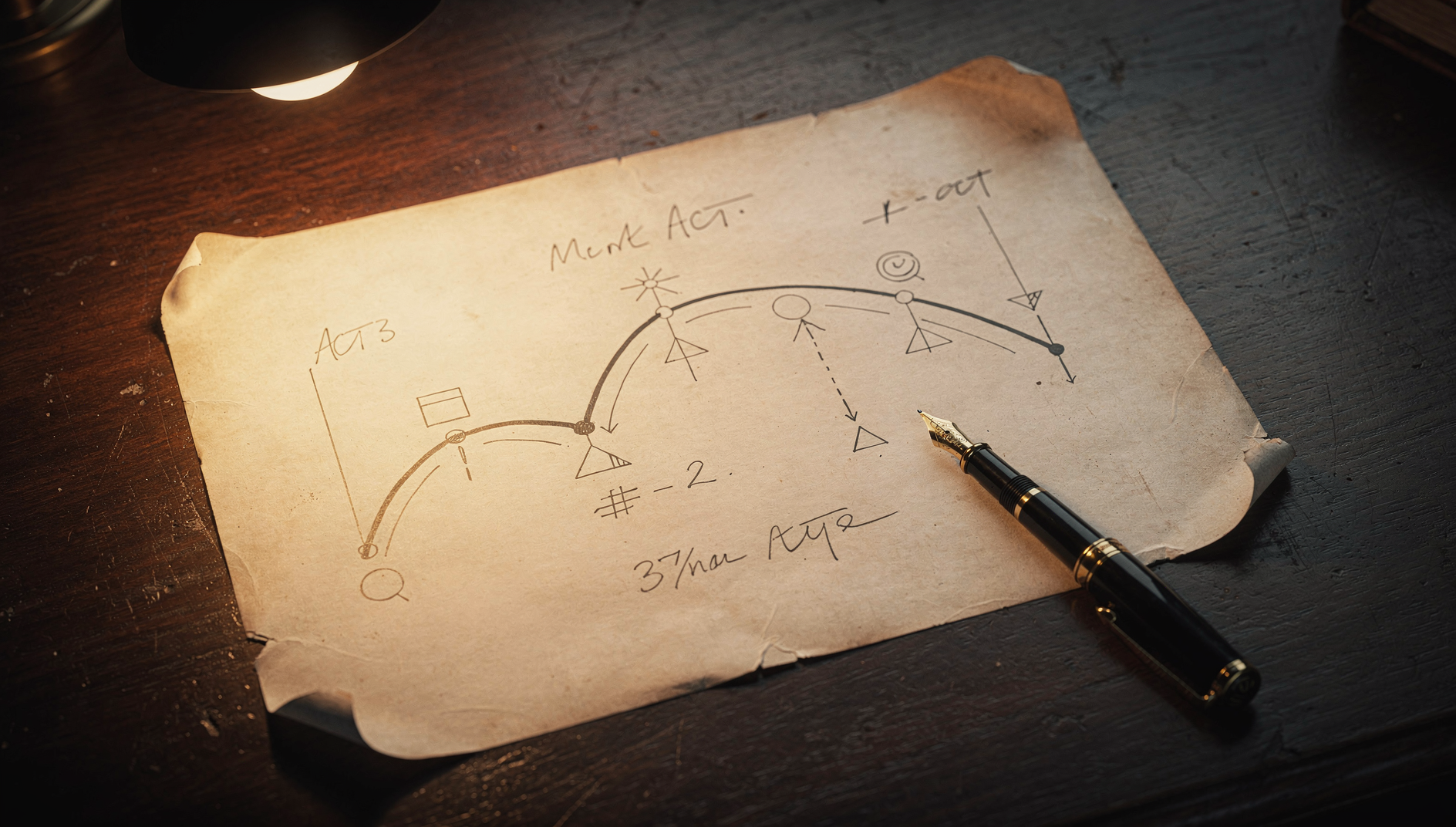
Three-act structure gets dismissed in two ways: by beginning writers who've never used it, and by experienced writers who think they've moved beyond it. Both are wrong in the same direction. Understanding what the three acts actually do - not just their names, but their dramatic function - is the difference between a script that feels inevitable and one that feels arbitrary.
This guide goes beyond the surface version ("Act One sets up, Act Two complicates, Act Three resolves") and into what's actually happening structurally in each section, and why.
What Structure Is Actually For
Structure exists to manage information and expectation. The audience wants to be surprised but not confused. They want to understand what's at stake but not know how it resolves. They want to feel that events are connected causally, not just chronologically.
Structure is the tool that maintains all of this simultaneously. A well-structured script makes the audience feel that the story couldn't have happened any other way - even though many paths were possible. That feeling of inevitability is what structure creates.
Act One: Establishing the World That Will Be Broken
Act One has three jobs: establish the protagonist's world, introduce the central dramatic question, and set the story in motion. In a standard feature film (90-120 pages), this happens in roughly the first 25 pages.
The opening image is a compression of your entire film's themes. Chinatown opens on surveillance photographs - the film is about looking at things without understanding them. The Shining opens with an aerial shot following a car into isolation - the film is about being swallowed by something vast. Get the opening image right and you've told the audience what kind of film they're watching.
The protagonist's ordinary world matters because we need to understand what they're losing or risking. A character who has nothing has nothing to lose, which means nothing is at stake. Show us their life as it is before the story breaks it.
The inciting incident is the event that creates the central dramatic question. It's not necessarily the most dramatic moment in Act One - it's the moment that makes the story impossible to stop. In Jaws, it's the first shark attack. In Kramer vs. Kramer, it's the wife leaving. The inciting incident tells the audience: this is the problem. Everything that follows is the attempt to solve it.
The Act One break - the moment around page 25-30 that launches Act Two - is usually a point of no return. The protagonist crosses a threshold they can't uncross. They commit to something. The story can no longer return to the ordinary world established in the opening.
Act Two: The Sustained Complication
Act Two is the hardest act to write and the one most scripts fail in. It runs from roughly page 30 to page 75-80, which means it's about half the entire screenplay. It has to maintain dramatic momentum for fifty pages without the structural anchors that Act One and Act Three provide.
The key to Act Two is understanding that it isn't a single block of complication - it has its own internal structure. The midpoint (around page 55-60) divides Act Two into two distinct halves with different dramatic functions.
Act Two A is rising action. The protagonist is pursuing their goal, encountering obstacles, making progress, suffering setbacks. The dramatic question is open but not yet desperate. The protagonist still has options.
The midpoint shifts the energy fundamentally. Something happens that changes the nature of the conflict: new information arrives, the stakes escalate, the protagonist's approach is revealed to be wrong, or they experience a false victory followed by a collapse. After the midpoint, the story moves differently.
Act Two B is where everything gets worse. The protagonist is more committed but more compromised. Subplots converge on the main plot. The antagonistic forces are at their strongest. The low point - usually around page 75 - is where everything falls apart: the plan fails, the relationship breaks, the character's fatal flaw becomes impossible to ignore.
The Act Two break launches Act Three. It's usually the protagonist making a final commitment based on what they've learned. The low point has stripped away their illusions. What remains is the essential conflict.
Act Three: The Inevitable Confrontation
Act Three resolves the dramatic question established in Act One. Not necessarily in the protagonist's favor - plenty of great films end in failure or ambiguity - but definitively. The audience needs to know whether the central question was answered, even if the answer is tragic.
The climax is the confrontation between the protagonist and whatever has been opposing them (person, force, internal obstacle). It should feel like the destination the whole film was driving toward. If it surprises the audience completely, you haven't set it up correctly. If it's entirely predictable, you haven't complicated it enough. The climax should feel both surprising and inevitable.
The resolution shows us the new world created by the story's events. The opening image and the closing image are often deliberately echoed - showing what's changed. A script that ends exactly where it began has failed to move.
The Mistakes Most Writers Make
Confusing plot events with dramatic events. An explosion is a plot event. The protagonist choosing to sacrifice themselves to stop the explosion is a dramatic event. Act breaks are always dramatic events, not plot events. If your Act One break is "the protagonist learns about the treasure" and not "the protagonist commits to getting the treasure," you're marking the wrong beat.
Making Act Two a series of unconnected obstacles. Act Two needs escalating causation - each event causes the next, and each event is worse than the last. A series of random obstacles (obstacle, obstacle, obstacle) creates a feeling of treadmill, not progression. The obstacles need to be connected to each other and to the protagonist's fatal flaw.
Resolving too early. The climax should be in Act Three, not late Act Two. If your protagonist solves the main problem on page 85 of a 110-page script, the last 25 pages will feel like aftermath rather than story. Don't let the air out of the balloon too soon.
Ignoring the low point. The low point in late Act Two is where most scripts go soft. Writers are reluctant to make things truly bad for their protagonists. But the audience can only believe in the final victory if they believe the final defeat was possible. Make it genuinely bad.
Structure vs. Formula
The pushback against three-act structure usually comes from conflating structure with formula. Formula is "hero wants X, mentor appears, hero fails, hero tries again, hero succeeds." That's a bad script, and it has the beats of three-act structure. But so does Chinatown, There Will Be Blood, Portrait of a Lady on Fire, and Parasite - none of which feel formulaic.
Structure is a description of how dramatic momentum works. It tells you where to put weight, not what the weight should be. Every story that creates and sustains tension in an audience is using some version of these principles, whether the writer was thinking about them explicitly or not.
The writers who say "I don't use three-act structure" usually mean "I don't think about it consciously while drafting." They're still using it. Their instincts for when a scene feels slow, when a character needs to commit, when a climax has landed - those instincts are structural instincts, developed by watching and reading stories that work.
Understanding structure consciously doesn't replace instinct. It gives you language for what's wrong when something is wrong, and a framework for fixing it. That's all it's for.
Using Structure in plotwell's Beat Sheet
plotwell's beat sheet view is built around this structure. You can create beats for each of the structural moments - inciting incident, Act One break, midpoint, low point, climax - and arrange your story beats around them before you write a single scene.
The value isn't the labels. It's being able to look at your entire story at once and see where the dramatic weight falls. If your beat sheet has fifteen beats in Act One and four in Act Two, you'll know before you write a word that Act Two needs work. That diagnosis at the outline stage costs one afternoon. The same diagnosis at the draft stage costs weeks.
Structural problems are easier to fix in the outline than in the draft. Use the outline to find them.