plotwellplotwell
Start free

Write your script.Plan the whole film.

From one screenplay to storyboards, schedules and call sheets.

Start freeFree plan - No credit card - Runs in your browser
|Ash & Ember
909LT
Untitled Script
1.
1INT. HAVEN - MAINTENANCE BAY - DAY
The maintenance bay is a cathedral of salvage. Reclaimed pipes snake up the walls, oil-dark and sweating. Sodium lamps buzz overhead, casting everything in amber. Aura, nineteen, hangs upside down inside the guts of a failing filtration pump, her legs hooked around a rusted frame, a respirator mask hanging loose around her neck.
She works with the focus of someone who has done this a thousand times. Her fingerless gloves are stained with grease. A faded scar crosses her left eyebrow. Her hands move with the quiet confidence of a surgeon, but there is a tension in her jaw that has nothing to do with the machinery.
Aura tightens a bolt, then stops. She taps a corroded valve with the back of her wrench. A dull, hollow sound. She taps it again.
AURA
(under her breath)
That's not supposed to sound like that.
She swings down, landing on the grated floor with a soft thud. Wipes her forehead with the back of her glove, leaving a smear of grease across her brow. She studies the pump the way you would study a patient who is not telling you the truth.
The bay door grinds open. ELDER MARCUS, seventy, stooped and gray, enters carrying a coil of cable over his shoulder. His welding goggles hang around his neck. He watches her for a moment before speaking.
MARCUS
You have been at that pump since before the bells.
AURA
It is dying.
MARCUS
Everything is dying. The trick is keeping it alive long enough to matter.

Build the world before you write in it.

Characters, places and the look of both. Written once, then used by every scene, every storyboard frame and every call sheet that comes after.

  1. AURA

    AURA

    Protagonist

  2. ELDER MARCUS

    ELDER MARCUS

    Mentor / father figure

  3. JUNO

    JUNO

    Outside ally / catalyst

  4. OVERSEER SABLE

    OVERSEER SABLE

    Antagonist

The page, and a read on it.

Industry formatting you never have to think about, and an analysis pass that marks the exact words it means, on the page itself, with the note one click away.

Script Doctor3 issues82
1.

INT. HAVEN - MAINTENANCE BAY - DAY

The maintenance bay is a cathedral of salvage. Reclaimed pipes snake up the walls, oil-dark and sweating. Sodium lamps buzz overhead, casting everything in amber. Aura, nineteen, hangs upside down inside the guts of a failing filtration pump, her legs hooked around a rusted frame, a respirator mask hanging loose around her neck.

She works with the focus of someone who has done this a thousand times. Her fingerless gloves are stained with grease. A faded scar crosses her left eyebrow. Her hands move with the quiet confidence of a surgeon, but there is a tension in her jaw that has nothing to do with the machinery.

Aura tightens a bolt, then stops. She taps a corroded valve with the back of her wrench. A dull, hollow sound. She taps it again.

AURA

(under her breath)

That's not supposed to sound like that.

She swings down, landing on the grated floor with a soft thud. Wipes her forehead with the back of her glove, leaving a smear of grease across her brow. She studies the pump the way you would study a patient who is not telling you the truth.

Character

Scene 1

Excerpt

"She works with the focus of someone who has done this a thousand times."

Aura is competent and interesting, but nothing is at stake for her yet. She has no want in this scene.

Suggestion

Give her something she is trying to get before the pump fails, however small.

DismissAcknowledge

The scene you wrote, as shots.

INT. HAVEN - MAINTENANCE BAY - DAY

WrittenThe maintenance bay is a cathedral of salvage.

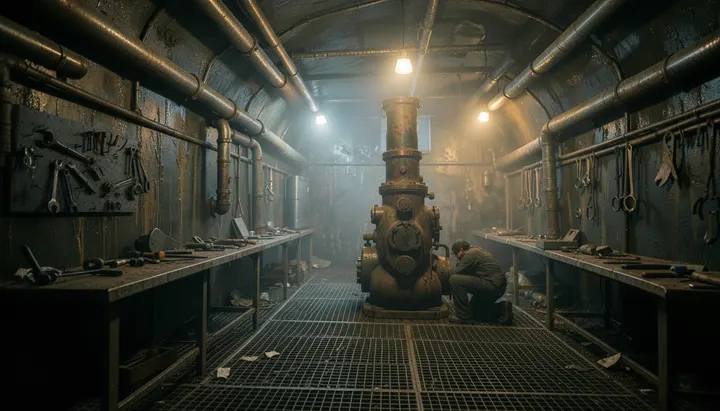
ShotExtreme-wide establishing shot of the maintenance bay: reclaimed pipes snake up oil-dark walls under buzzing sodium lamps.

  1. Extreme-wide establishing shot of the maintenance bay: reclaimed pipes snake up oil-dark walls under buzzing sodium lamps.

    01Extreme widePan left6s

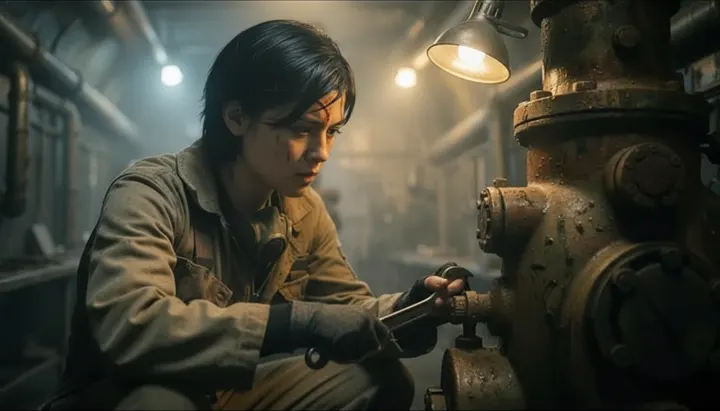
  2. Medium close-up on Aura at the open pump casing: her wrench on a corroded bolt, a faded scar over her eyebrow, lit hard from below.

    02Close-upZoom in5s

  3. Wide shot of Aura crouched on the grated floor after dropping down, one hand still on the frame, looking up at the machine.

    03MediumDolly out4s

  4. Over-the-shoulder shot from behind Aura, who studies the pump like a patient hiding the truth.

    04Over the shoulderZoom out6s

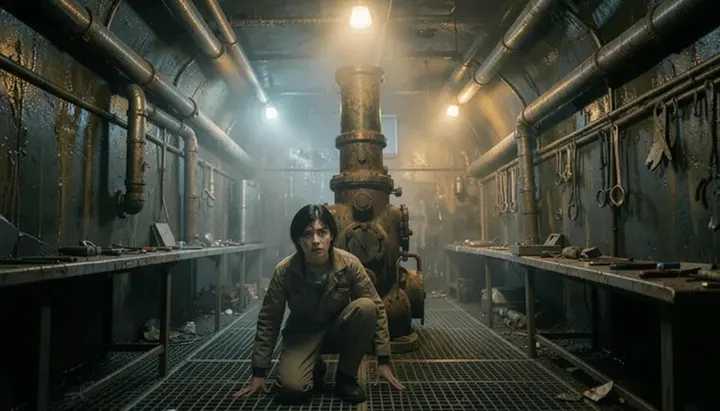
These four frames are shots 1 to 4 of the scene above. plotwell generated them from the script itself, with the character and the location it already knows, so the person in frame 2 is the same person in frame 4.

The shoot, scene by scene.

Assign each scene a shoot date and a filming location, and the schedule that feeds the call sheet builds itself. It is the breakdown view the production team works from.

3 scenes0/3 Scheduled0 Shoot days
Assign shoot dates and locations to scenes to generate call sheets.
1INT. HAVEN - MAINTENANCE BAY - DAYINTDayNo dateNo location
2EXT. HAVEN - THE WATER TOWER - DUSKEXTDuskNo dateNo location
3EXT. HAVEN - THE SOUTH GATE - NIGHTEXTNightNo dateNo location

Everything in one project, not four tools.

The script in Word, the storyboard in another app, the budget in a spreadsheet. Here you change something once and it comes out changed everywhere else.

Start from what you already wrote.

Drop in a PDF, a Final Draft file or a Word document. plotwell reads the formatting and hands back scenes, not a wall of text.

ash-and-ember.pdf

3 scenes

  1. 1INT. HAVEN - MAINTENANCE BAY - DAY
  2. 2EXT. HAVEN - THE WATER TOWER - DUSK
  3. 3EXT. HAVEN - THE SOUTH GATE - NIGHT

Change it once.

Rename a character in the script: the breakdown, the storyboard and the call sheet follow. Nothing here is typed twice.

AURA VEGA
  • Breakdown
  • Storyboard
  • Call sheet

The AI has read your project.

Every request carries your scenes, your cast, your locations and the look you chose. You get a note about your film, not about films in general.

Give me a note on scene 1.

  • 3scenes
  • 5characters
  • 8locations
  • Visual style
Marcus warns Aura about the pump before we have seen him near it. Move his entrance one beat earlier and the warning lands.

Two people, one page.

Your co-writer edits the scene while you are in it, and your producer reads the plan. Comments land on the line they are about.

YouDana
Can we lose the second beat here?

FAQ

Questions people ask first

Is plotwell really free?

Yes. The free plan gives you one project, one collaborator and every feature in the product, with no credit card and no time limit. There is no base subscription: you add a second project or a second collaborator for $3 a month each, only when you need one.

Do I have to install anything?

No. plotwell runs in the browser on any machine, and your work saves as you write. Exports are standard files you own: PDF with a cover page, Fountain, and Final Draft (.fdx).

Can I bring in a script I have already started?

Yes. plotwell imports Final Draft (.fdx) and Fountain files directly, and reads PDF and Word documents in your browser without uploading them anywhere. Formatting is recognised on the way in, so a script arrives as a script rather than as a wall of text.

What does the AI actually do?

It drafts and it reads. Script Doctor analyses a draft and marks the exact words it has something to say about, on the page, with the note one click away. The agent knows your characters and locations, so it can draft a scene, rewrite a line, or generate storyboard frames where the person in frame two is the same person in frame four. You edit everything it writes.

Does it replace my production tools too?

That is the point of it. The same script produces the scene breakdown, the stripboard, the shooting schedule, the budget and the call sheets, so the cast on the call sheet is the cast in the scene rather than something retyped into a spreadsheet. Change a line in the script and everything downstream knows.

Does it work for a series, not just a feature?

Yes, and a series is a first-class project rather than a folder of features. Seasons and episodes each carry their own script, storyboard, breakdown and budget, while the characters, locations and look are written once and used by every episode after them. Vertical and web series work the same way.