

Structural problems in a screenplay rarely announce themselves. They hide behind good scenes, sharp dialogue, and technically correct formatting. You can read a script three times and still miss the fact that your protagonist doesn't make a meaningful choice until page 75 of a 90-page script. By the time the problem surfaces - usually when a producer reads it or when you're in the editing room - it's expensive to fix.
The solution is diagnosis before production. What follows is a systematic approach to finding structural problems in your own work, and what to do about each one.
The Four Categories of Structural Problems
Most script problems fall into one of four categories: pacing, agency, clarity, and consequence. A script can have problems in multiple categories simultaneously, which is why broad notes like "it feels slow" or "I don't care about the character" are useless - they name the symptom without locating the cause.
Pacing Problems
Pacing is often misunderstood as the speed at which things happen. It's actually the relationship between what's happening and what the audience knows is at stake. A scene that moves quickly can feel slow if nothing meaningful is at risk in it. A scene that moves slowly can feel propulsive if the stakes are clear and the outcome is uncertain.
How to diagnose it: Go through your script and mark every scene where the dramatic question ("will X happen?") changes. If you go more than fifteen pages without the dramatic question shifting, you probably have a pacing problem in that section.
The fix: Scenes without dramatic movement are usually either world-building (information delivery) or character observation (showing us who someone is without context). Both have their place, but they need to be cut shorter or repositioned. A scene that shows us a character's daily routine is only useful if we're about to watch that routine get disrupted. Move it immediately before the disruption, cut it to its essential beats, and the pacing problem often resolves itself.
Agency Problems
Agency is whether your protagonist is making choices that drive the story or whether the story is happening to them. This is the root cause behind the note "I don't care about the character." You don't care because the character isn't doing anything - they're reacting.
How to diagnose it: In every scene where your protagonist is present, ask: what did they want before the scene started, and what did they do to pursue it? If the answer to the second question is "nothing - they responded to what the other character did," you may have an agency problem.
The fix: Agency problems are usually structural rather than scene-level. They emerge when the protagonist's goal isn't clear enough to generate forward motion on its own. The fix is usually to strengthen the want - make it more specific, more urgent, more personal - so that the character has clear reasons to initiate action rather than wait for the story to come to them.
Clarity Problems
Clarity problems mean the audience doesn't understand what's happening, why it matters, or what a character wants. This is different from intentional ambiguity (which creates tension) - it's unintentional confusion that causes the reader to disengage.
How to diagnose it: Ask someone who hasn't read the script to summarize the story after reading the first thirty pages. If they can't explain what the protagonist wants and what's in the way, you have a clarity problem in your first act.
The fix: Clarity problems in the first act are almost always solved by making the protagonist's goal more concrete and the stakes more specific earlier. Instead of "she wants her life to change," try "she needs to find a new investor before her business closes on Friday." The first is a state of being. The second is an event with a deadline.
Clarity problems in the middle act are usually caused by subplots that aren't clearly connected to the main plot. Audiences can track multiple threads, but each thread needs a visible connection to the central dramatic question or they feel like distractions.
Consequence Problems
Consequence problems occur when characters' choices don't produce meaningful results. A character makes a decision, and nothing really changes because of it. The story continues on roughly the same course it was already on.
How to diagnose it: Mark every major decision your protagonist makes. For each one, ask: how would the story be different if they had made the opposite choice? If the story would be essentially the same either way, the decision doesn't have real consequences.
The fix: Consequence problems are usually a sign that the story's design hasn't committed to the choices it's making. The fix is to increase what's lost and what's gained by each major decision - and to make those gains and losses visible in subsequent scenes. If a character lies to protect themselves in Act One, there should be a scene later where that lie creates a specific problem. If there isn't, the lie had no consequence.
The Systematic Pass
Once you understand these categories, do a systematic pass through your script with each one in mind. Don't try to solve everything at once - that leads to overwriting. Instead:
First pass: identify pacing problems. Mark every scene that doesn't change the dramatic question. Circle the regions where the question goes unchanged for too long.
Second pass: identify agency problems. Read only your protagonist's scenes and track what they initiate versus what they respond to. The ratio should lean toward initiative.
Third pass: identify clarity problems. Read the first and last scenes of each act and ask whether a reader who started reading there would understand the situation.
Fourth pass: identify consequence problems. List the protagonist's five most important decisions. For each, trace the visible consequence in the story.
After each pass, make notes. Don't start rewriting until you've done all four passes - you may find that a pacing problem in Act Two is caused by an agency problem in Act One, and fixing the root cause solves both.
What the Script Doctor Actually Does
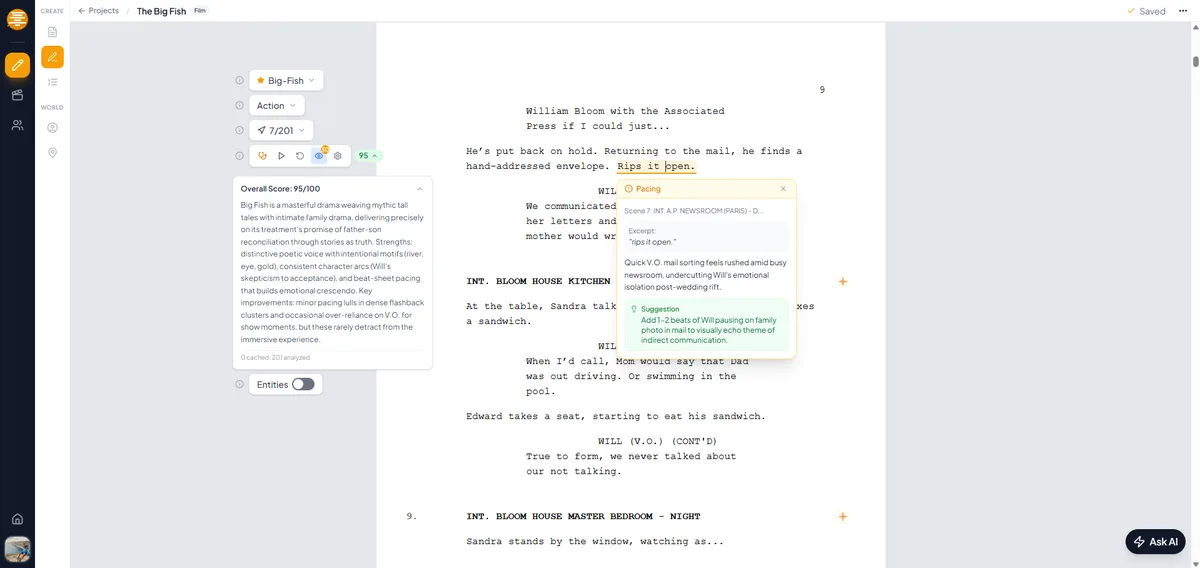
AI-powered script analysis tools like plotwell's Script Doctor work on these exact principles. The tool reads your full script and surfaces specific issues - not vague feedback like "this scene feels slow," but specific observations: "Scene 12 contains no new information and no change in character situation. Consider cutting or repositioning it," or "The protagonist does not initiate any action in Scenes 14-22. This section may feel passive."
The value isn't that the analysis is always right - it often flags things that are intentional choices. The value is that it reads the whole script simultaneously, without the cognitive biases a human reader brings. It doesn't get caught up in a particularly good scene and forget to notice that the scene before it doesn't connect to anything. It treats every scene with the same level of attention.
Use the Script Doctor's output as a list of questions to investigate, not as a list of problems to fix. "Is this actually a pacing problem or is it intentional breathing room?" is a question worth asking. The notes give you the question. Your judgment provides the answer.
A Note on Timing
None of this is useful after you've started principal photography. The diagnostic pass described above should happen at the end of your first complete draft, before you share it with anyone. A script that's been diagnosed and treated is a script you can defend. A script you haven't examined carefully is a script you're hoping for.
The most expensive words in filmmaking are "we'll fix it in post." The second most expensive words are "we should have caught that in the script." Both are avoidable. The first requires discipline in the editing room. The second requires a systematic diagnostic pass before you lock the script.
Do the pass. It takes a day. It saves weeks.