
Film is primarily a visual medium. This statement is obvious and routinely ignored. Films that rely on dialogue to carry all dramatic weight, that use the camera as a passive recorder rather than an active narrator, are missing the medium's most powerful tools.
Visual storytelling is the discipline of letting the camera do work that writers try to put in dialogue and directors try to put in performance. Here's what the vocabulary is, and how to use it.
Shot Scale and What It Communicates
Shot scale - how close the camera is to the subject - is the most fundamental element of visual storytelling. Each scale communicates different information and creates a different relationship between the audience and the subject.
Wide shot / establishing shot: Shows the environment. We see the full space the character inhabits, which tells us something about their world before they do anything. A character who lives in a vast, empty apartment feels different from a character in a cramped, cluttered one. The establishing shot makes this statement visually before the story begins.
Medium shot: The neutral shot. Most of the storytelling in a dialogue scene happens in medium shots - we see the characters from roughly the waist up, which gives us their expressions and their body language. Medium shots are transactional; they're where the content of a scene is communicated.
Close-up: Significance and interiority. A close-up tells the audience: this matters. Whether it's a character's face in a moment of realization or an object that's about to be important, the close-up is a declaration that the camera has singled something out. Use it selectively. A film full of close-ups has diluted the tool.
Extreme close-up: Intensity and detail. An eye. A hand. The mechanism of a lock. The extreme close-up removes context and forces attention. It can create intimacy (the character's expression in an extreme close-up creates a private connection with the audience) or tension (a ticking timer fills the screen).
Camera Angle and Power
Where the camera is positioned relative to the subject communicates the power relationship between them.
Eye level: Neutral, observational. The camera is a peer of the character. This is the default.
Low angle (camera below the subject): The subject appears powerful, dominant, threatening. The classic villain shot. Also used for moments when a character achieves something - the camera looking up at them reflects the audience's admiration.
High angle (camera above the subject): The subject appears small, vulnerable, observed. Characters who are defeated, trapped, or watched by forces larger than themselves are often shot from high angles.
Dutch angle / canted angle: The horizon is tilted. This communicates psychological instability, threat, or wrongness. Used sparingly, it tells the audience that something is off. Overused, it becomes visual noise.
Movement and Its Effect
Camera movement creates meaning through association with what it's doing and when.
Static camera: Stability, objectivity, formality. A static camera observing a scene puts distance between the audience and the action. The scene unfolds as if the camera has no point of view about what it's watching. This can create unease (the camera observes something terrible dispassionately) or intimacy (the camera stays with a character through an extended quiet moment).
Dolly / track: The camera moves through space in a controlled way. Moving toward a character can signal that we're entering their perspective; pulling away can signal isolation or revelation. The track shot can reveal information gradually - we see a character's face before the camera pulls back to reveal the space they're in.
Handheld / shoulder rig: Unstable, subjective, immediate. Handheld camera places the audience inside the action rather than outside it. It's used to create the feeling of being present in a scene, particularly in action or documentary-style sequences. Overuse creates visual fatigue.
Crane / drone: A camera that moves vertically or through high space creates a sense of scale - of the character's smallness relative to their environment, or of the epic scope of what they're facing. These moves are expensive and should be used when the shot earns its cost.
Composition and the Rule of Thirds
The rule of thirds is the basic compositional principle: divide the frame into a 3x3 grid and place important elements at the intersections of the grid lines rather than in the center. A character whose eye is on an intersection point appears in a more dynamic composition than a character whose eye is centered.
More important than the rule itself is understanding what composition communicates. A character placed at the left edge of the frame with empty space to their right appears isolated, or as if they're facing something ahead of them we can't see. Two characters in the same frame, positioned at opposite edges, appear in conflict - even if they're having a polite conversation.
Lead room / look room: When a character is looking in a specific direction, leave space in the frame in the direction they're looking. A character looking right, positioned at the right edge of the frame with no space ahead of them, creates a feeling of constriction or threat. The same character positioned at the left edge with space to the right feels open, expectant.
Depth: Foreground elements in sharp focus with background elements blurred create depth and layering. Placing a character in the foreground with something meaningful happening in the background - and keeping both in focus - can tell two stories simultaneously.
The Storyboard as a Visual Language Tool
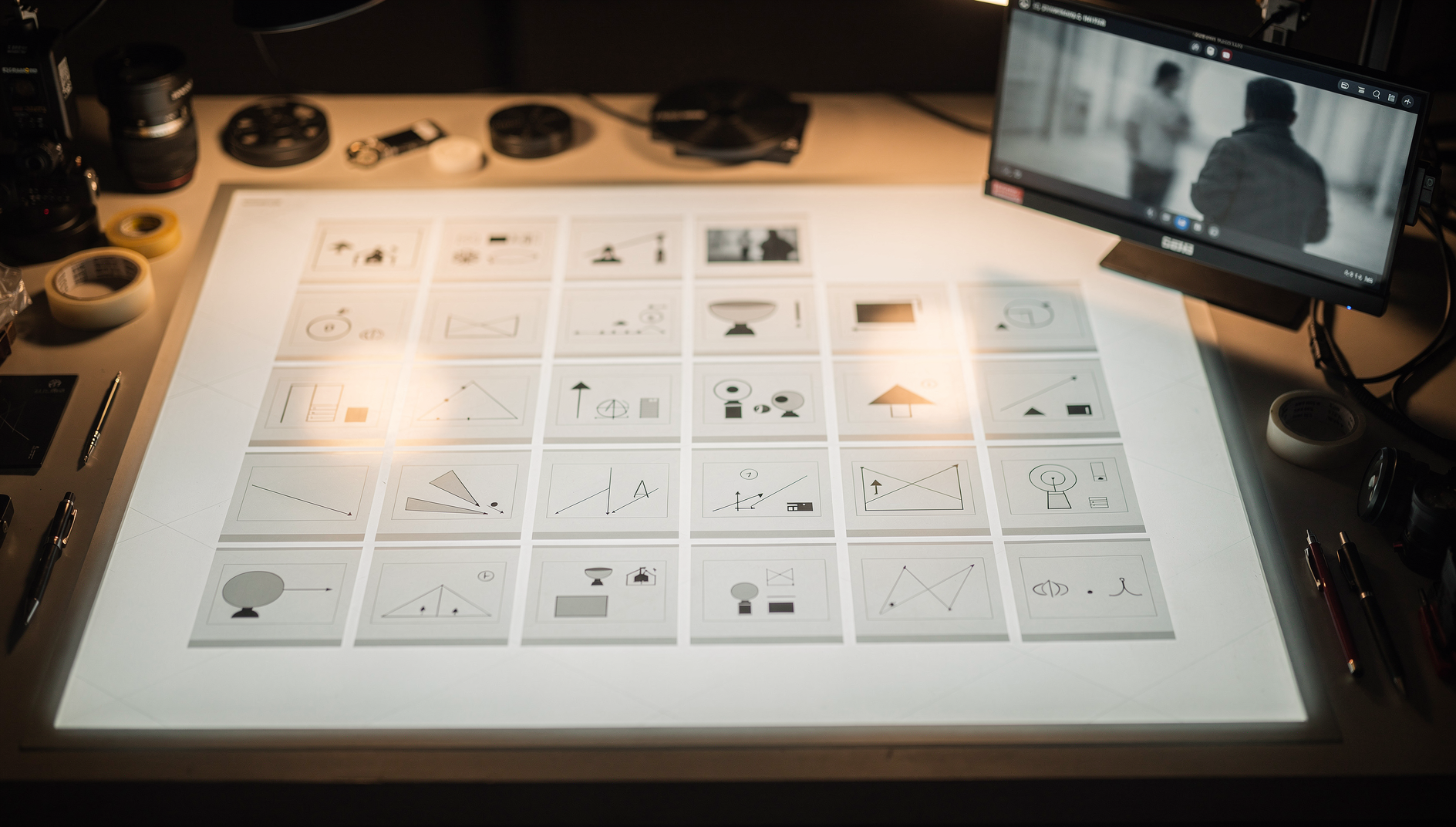
The decisions described above need to be made before the camera turns on. A storyboard is where visual language choices get made systematically, rather than improvised under production pressure.
When you board a scene, you're answering these questions for every shot: what scale, what angle, what movement, what composition? The answers create a visual argument for the scene - a coherent point of view that the camera is making about what's happening.
In plotwell's storyboard view, you can describe each panel's visual intention and let the AI generate a rough version of the image. The generated image won't be photographic quality, but it's sufficient to evaluate whether the compositional choices you're making work - whether the framing creates the right relationship between characters, whether the shot scale is appropriate for the moment, whether the sequence of shots creates a visual rhythm.
The storyboard is where you find the shots that are wrong before the shoot, not during it. A shot that looked right in your head but doesn't work on the page costs nothing to fix. The same discovery on set costs an hour.
Learn the vocabulary. Build the board. Show up to the shoot knowing what the camera is going to say.