
A screenplay tells a story. A scene breakdown turns that story into a production document - a structured list of everything you need in order to shoot each scene. The breakdown is where the creative work of writing meets the logistical work of production, and most of the scheduling, budgeting, and casting decisions that follow depend on getting it right.
This guide covers what a scene breakdown actually is, what information to extract from each scene, and how to use that information to build a shooting schedule that's grounded in reality.
What a Scene Breakdown Is
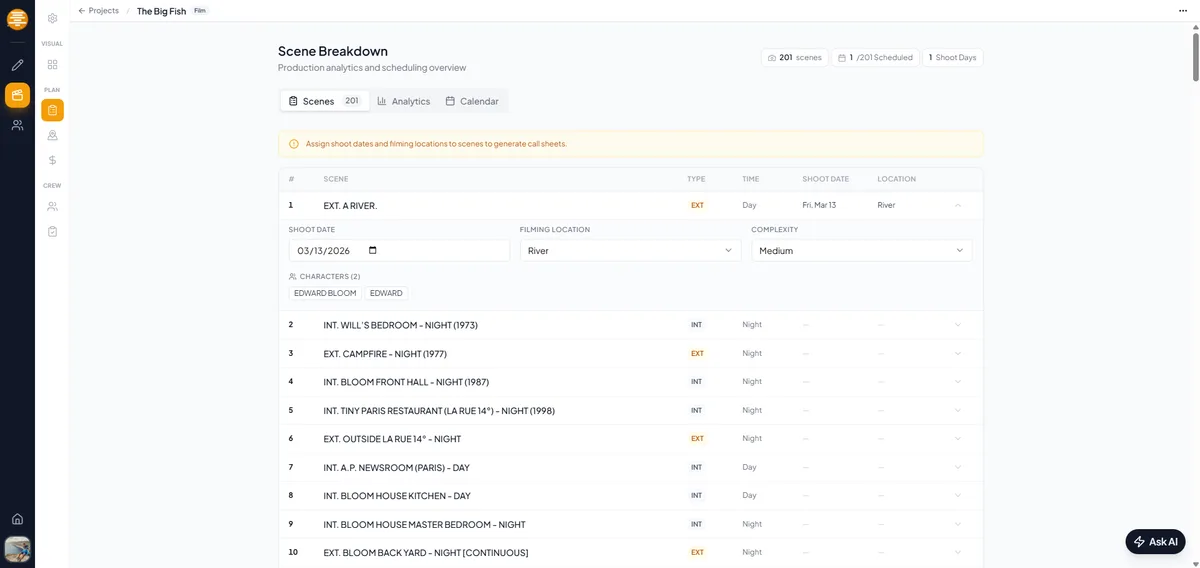
A breakdown is a database of production requirements extracted from the script. For each scene, you record:
- Scene number and heading - the slug line (INT. COFFEE SHOP - DAY)
- Location type - interior or exterior
- Time of day - day, night, dawn, dusk
- Characters present - every speaking and significant non-speaking role
- Extras - background actors, and roughly how many
- Props - items that are handled, used, or prominently featured
- Wardrobe - costumes specific to this scene (especially if different from a character's default)
- Special requirements - stunts, effects, vehicles, animals, weapons, special makeup
- Page count - how many pages the scene runs (in eighths: 1/8, 2/8, etc.)
This information, collected for every scene, gives your production team the raw material to build a schedule, a budget, and a call sheet system.
Why the Page Count Matters
One of the most useful numbers in a breakdown is the page count per scene, measured in eighths of a page. Film production has long used this convention: one page of properly formatted screenplay equals approximately one minute of screen time, and a typical crew can shoot between two and five pages per day depending on complexity.
Measuring in eighths rather than whole pages gives you granular data for scheduling. A scene that's 3/8 of a page should take far less time than a scene that's 14/8. When you sum the eighths across scenes and group them by shooting day, you can see whether a given day is realistically achievable before you've committed to a location or a cast availability window.
In plotwell's scene breakdown view, page counts are calculated automatically from the script. The system reads the script, identifies scene boundaries, and calculates the length of each scene in eighths. This gives you the breakdown data as a starting point rather than something you have to compute by hand.
Grouping Scenes for the Schedule
Once you have a complete breakdown, the scheduling process is about grouping scenes that can be shot together to minimize company moves (changes of location) and to accommodate cast and equipment constraints.
The guiding principle is: shoot by location, not by script order. If you have twelve scenes set in the same apartment, shooting them on consecutive days is far more efficient than moving to the apartment for one scene, shooting somewhere else for three days, then returning for the rest. The story plays in script order. The shoot doesn't have to.
The practical constraints that shape grouping are:
Cast Availability
Actors with limited availability need to have their scenes clustered. If your lead actor is only available for fifteen shooting days out of a twenty-day schedule, their scenes need to be concentrated in those fifteen days. This often forces you to make suboptimal location groupings elsewhere - a constraint you need to know about early.
Location Permits and Logistics
Some locations are only available on specific days. A location that requires a city permit for street closure, for example, has to be scheduled around the permit window. Exterior locations dependent on weather need buffer days built around them. The schedule has to reflect these constraints explicitly, not optimistically.
Lighting and Time of Day
Day scenes and night scenes require different lighting setups. If your schedule puts a day exterior and a night interior in the same shooting day, the company will wrap the day exterior, break down the equipment, set up for night, and shoot into the early hours. This is achievable but exhausting and increases overtime risk. Grouping all day work in the first half of a shooting week and night work in the second half is often more efficient.
Technical Requirements
Scenes with special requirements - water rigs, stunt coordination, vehicle mounts - take longer to set up than regular scenes. Group them on dedicated days with appropriate time allotments and the right crew called in. Don't put a stunt sequence on the same day as a delicate emotional dialogue scene that will require many takes.
Building the Stripboard
The traditional tool for scheduling is the stripboard - a physical or digital board where each scene is represented by a colored strip. Different colors represent different elements: day exteriors, night interiors, scenes with stunts, scenes with children (who have restricted working hours), and so on.
In digital production tools including plotwell, the stripboard is a drag-and-drop interface where you move scenes between shooting days and see the page count, cast requirements, and special flags update in real time. The color coding makes it immediately visible if a day is over-scheduled or if a character is being called on a day when their other scenes don't warrant it.
A useful heuristic: build the schedule for your most constrained element first. If a cast member is only available for specific days, lock their scenes first and build the rest of the schedule around those anchors. If a location has a hard out time, schedule it first and fill the remaining days around it.
The Breakdown as a Living Document
A breakdown is not something you do once at the start of pre-production and then put away. It changes when:
- The script changes (new scenes, cut scenes, changed locations)
- Locations change (you lost the permit, found a better option, discovered the original location is unavailable)
- Cast changes (replacement casting, availability shifts)
- Budget forces cuts (some scenes get reduced in scope or cut entirely)
In a traditional workflow, this means re-doing breakdown paperwork manually. In a tool that reads the script and populates the breakdown, script changes propagate automatically - new scenes appear in the breakdown, deleted scenes disappear, and the page counts stay accurate without manual recalculation.
The schedule, however, still requires human judgment. The system can tell you that Scene 14 is now three pages longer than it was. You have to decide which day to extend, what to move, and how to communicate the change to the department heads affected.
Common Breakdown Mistakes
Undercounting extras. It's easy to write "CROWDED COFFEE SHOP" in the scene heading and then forget to note how many background actors that actually requires. When the budget is built, "some background" becomes a line item - and if you haven't quantified it, someone will quantify it for you, usually wrong. Count your extras in the breakdown.
Ignoring travel time. A company move from one location to another takes time - loading equipment, driving, unloading, setting up. A company move that takes forty-five minutes in each direction eats ninety minutes out of your shooting day. If your schedule has two company moves in a day, that's potentially three hours of shooting time lost. Build travel time into the schedule explicitly.
Optimistic page counts per day. New producers routinely schedule more pages per day than their crew can actually achieve. The industry average for a modest drama is two to three pages per day. A complex action scene might be half a page per day. Build your schedule from realistic production rates, not from how many pages you need to shoot divided by how many days you have.
Assuming good weather. For exterior shoots, always have a cover set (an interior scene you can move to if the weather is bad) and always have a weather-day buffer in the schedule. Exterior scenes that rely on specific natural light - magic hour, overcast skies - need flexibility in the schedule to find the right conditions.
From Breakdown to Call Sheet
Once the schedule is set, each day of the schedule becomes a call sheet. The call sheet tells each department:
- Which scenes are shooting today
- What time each cast member is called
- What equipment needs to be on set
- What the shooting order is
- What the backup plan is if something goes wrong
The call sheet is derived directly from the breakdown and the schedule. The department and cast requirements you recorded in the breakdown become the people and equipment listed on the call sheet. The connection is direct - which is why an inaccurate breakdown produces inaccurate call sheets and catch-up problems throughout production.
Get the breakdown right in pre-production. Everything else depends on it.