
You've written the script. Now what?
The gap between a finished screenplay and a first day of shooting is filled with production planning, the unsexy, essential work that determines whether your shoot runs smoothly or falls apart. Most indie films don't fail because of bad scripts or bad acting. They fail because of bad planning.
This guide walks you through every step of pre-production, in order, so nothing falls through the cracks.
The Pre-Production Timeline
For an indie feature, plan for 8-12 weeks of pre-production minimum. The phases overlap, but the general flow looks like this:
| Phase | What Happens |
|---|---|
| Script Breakdown | Extract every element from your script: cast, locations, props, wardrobe, special requirements |
| Budgeting | Turn your breakdown into a financial plan with contingency |
| Casting & Locations | Audition actors, scout locations, secure permits |
| Scheduling | Build the shooting schedule around cast availability and location groupings |
| Storyboarding | Visualize your shots, build shot lists |
| Final Prep | Call sheets, equipment orders, rehearsals, walkthroughs |
Everything feeds into everything else. Your budget affects your schedule. Your locations affect your budget. Your cast availability affects your locations. That's why planning is iterative, not linear.
Script Breakdown: The Foundation
The script breakdown is where production planning begins. You read through the screenplay and identify every element that needs to be organized, built, rented, hired, or scheduled.
For each scene, you need to extract: cast (who appears, extras, special skills), locations (INT/EXT, specific requirements), props (hero props, set dressing, consumables), wardrobe (costumes per scene, continuity), makeup (standard, SFX, prosthetics), and special equipment (stunts, vehicles, camera rigs).
Traditionally this means reading through your script with colored highlighters, one color per category. Each scene gets its own breakdown sheet. It's thorough but incredibly tedious.
With plotwell, your AI does the highlighting. Upload your script and the AI analyzes every scene, automatically extracting characters, locations, props, time of day, and special requirements. What takes a full day by hand takes minutes. And when you revise your script, the breakdown updates with it.
Budgeting
Your breakdown tells you what you need. Your budget tells you what you can afford.
The typical indie budget splits roughly: 20-30% above the line (writer, director, cast), 30-40% production (crew, equipment, locations), 15-25% post-production (edit, sound, color, VFX), and 10% contingency. Never skip the contingency. Something will always go wrong.
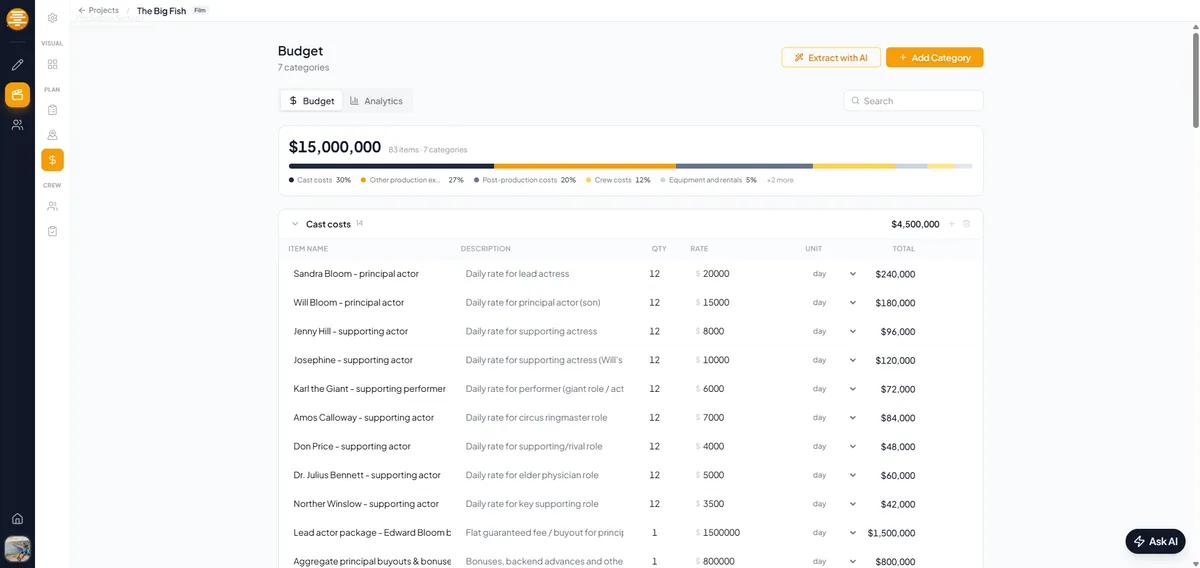
plotwell's budget analytics let you track spending by category, compare estimated vs. actual costs, and see at a glance where you're over or under. Visual dashboards replace spreadsheet chaos.
Casting & Locations
Casting starts with clear character descriptions from your treatments. plotwell automatically builds casting breakdowns from your character profiles, including scene appearances, dialogue frequency, and physical requirements. You know exactly how many shooting days each actor needs before you start negotiations.
Location scouting requires thinking about access, sound, lighting, permits, and continuity. In plotwell, every location links to the scenes where it appears. You can see how many shoot days each location needs, track permit status, and generate AI reference images to share your vision with scouts and production designers.
Scheduling
The shooting schedule determines what you shoot, when, and in what order. The core principles: group scenes by location (avoid company moves), respect actor availability, keep night shoots together, schedule weather-dependent exteriors with cover sets, and build in buffer time.
A Day Out of Days (DOOD) chart shows when each actor is needed across the entire shoot. plotwell builds this automatically from your script breakdown, so you can see actor overlap and scheduling conflicts at a glance.
Call Sheets
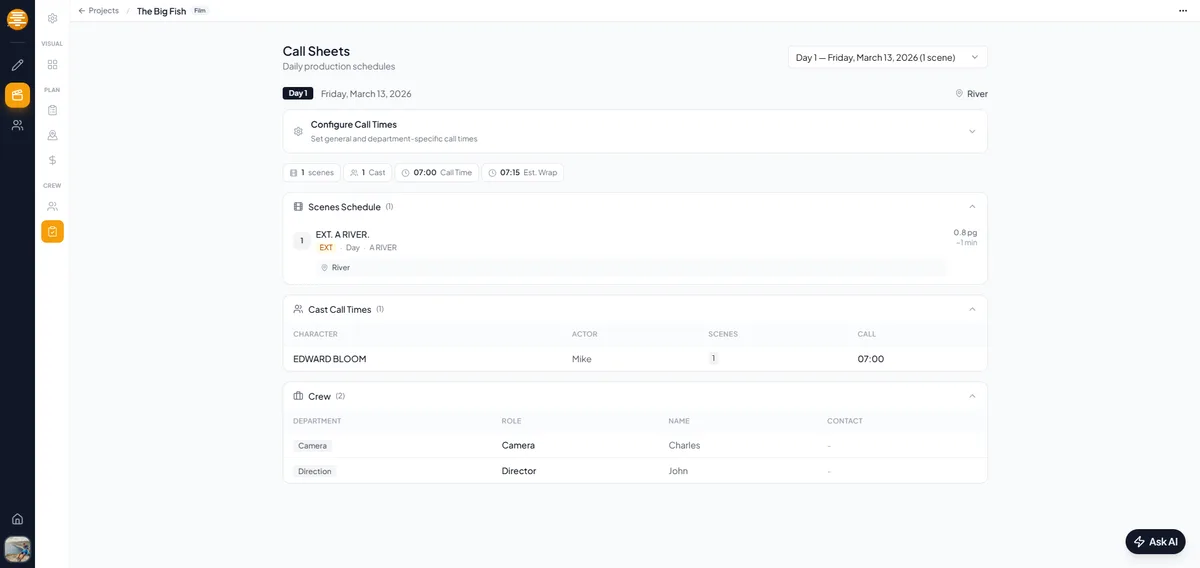
The call sheet is the daily plan that tells every crew member what scenes are shooting, what time to arrive, where to go, and who is needed.
plotwell generates call sheets directly from your schedule, pulling scene information, cast requirements, and location details automatically. No more copying data between spreadsheets. Export as professional PDFs and distribute to your team.
Production Planning with plotwell
plotwell is built to take you from finished script to camera-ready production, with tools that handle the tedious organizational work so you can focus on creative decisions.
AI Script Breakdown
Instead of manually reading through your script with a highlighter, plotwell's AI analyzes your screenplay and automatically extracts every production element: characters, locations, props, wardrobe, time of day, special requirements. What takes hours by hand takes minutes with AI.
The breakdown updates when your script changes. Edit a scene, and the production elements update accordingly.
Scene-by-Scene Breakdown View
The Breakdown view gives you a structured, scene-by-scene overview of your entire production. Each scene shows its cast, locations, props, and requirements at a glance. Filter by category to see all exterior night scenes, all scenes with a specific actor, or all scenes requiring special equipment.
Smart Location Management
Track every location in your project with details that matter for production: address, contact info, permits status, availability windows, and photos. plotwell links locations to the scenes where they appear, so you can see exactly how many shoot days each location needs.
Generate visual references for locations using AI image generation. Describe the look you want and get reference images to share with your production designer and location scout.
Character and Cast Tracking
Every character extracted from your script comes with their scene appearances automatically mapped. See your Day Out of Days at a glance. Track casting status, actor availability, and deal memos alongside the creative character work.
AI-Powered Storyboarding
Visualize your shots before you get to set. Describe a shot in plain language and plotwell generates a visual reference using AI. Build complete shot sequences scene by scene, with metadata for shot type, camera angle, and movement. Your storyboard becomes your shot list on set.
Budget Analytics
Track your production budget with visual analytics. See spending by category, compare estimated vs. actual costs, and identify where you're over or under budget. plotwell's budget tools help you make informed financial decisions throughout production.
Call Sheet Generation
Generate call sheets directly from your schedule. plotwell pulls scene information, cast requirements, and location details to create professional call sheets. No more copying data between spreadsheets.
AI Production Documents
Use plotwell's AI to generate production documents:
- Scene breakdowns from your script
- Character descriptions for casting breakdowns
- Location briefs for scouts
- Daily production reports templates
The AI understands your project's context because it has access to your full script, characters, and production data.
Real-Time Collaboration
Share your project with department heads and key crew. Everyone works from the same data: the AD sees the schedule, the costume designer sees the wardrobe breakdown, the producer sees the budget. Changes sync in real time, so no one works from outdated information.
Export Everything
Export your breakdowns, schedules, call sheets, and storyboards as professional PDFs. Take them to set, share them with investors, or attach them to crew packets.
The Pre-Production Checklist
Use this as your master checklist. Each item should be completed before principal photography:
Script
- Final draft locked
- Scene breakdown complete
- All elements identified and categorized
Business
- Budget finalized
- Financing secured
- Insurance in place
- LLC or production entity formed
Casting
- All roles cast
- Deals closed
- Actor availability confirmed
Locations
- All locations locked
- Permits obtained
- Location agreements signed
- Tech scouts completed
Crew
- Department heads hired
- Full crew confirmed
- Crew deals closed
Schedule
- Shooting schedule finalized
- Day Out of Days distributed
- Cover sets identified
Creative
- Storyboards/shot lists complete
- Rehearsals done
- Wardrobe fittings complete
- Props and set dressing sourced
Logistics
- Equipment ordered
- Transportation arranged
- Catering booked
- First week call sheets distributed
The Truth About Pre-Production
Pre-production is where amateur productions reveal themselves. A crew can feel the difference between a shoot that was planned and one that wasn't. When you've done the work, shooting days are focused and efficient. When you haven't, every day is a fire drill.
The time you invest in planning is the time you save on set. And set time is always the most expensive time in filmmaking.