

A great screenplay lives or dies on its characters. Plot is what happens. Character is why we care. And yet most writers spend far more time on plot mechanics than on understanding who their characters actually are.
A character treatment is the document that fixes this. It's where you discover who your characters are before you put words in their mouths.
What Is a Character Treatment?
A character treatment is a prose document that describes a character in depth: their backstory, psychology, desires, contradictions, and arc. It's not a bio or a stat sheet. It's an exploration of a human being.
Think of it as the iceberg under the surface. The audience will only see the tip (what the character says and does on screen), but the treatment gives the writer the full picture so every choice feels grounded.
The Elements of a Strong Character Treatment
1. The Wound
Every compelling character carries a wound, something that happened before the story begins that shaped how they see the world.
In Big Fish, Will Bloom's wound is growing up with a father whose stories felt like lies. He internalized it as: "My father chose his stories over me." That wound drives every scene, every argument, every moment of resistance.
The wound doesn't need to be dramatic. It can be subtle: a parent who was emotionally absent, a childhood humiliation, a betrayal by a friend. What matters is that it created a belief system the character still operates from.
Write this first. Everything else flows from the wound.
2. The Want vs. The Need
Every character wants something concrete (the external goal) and needs something deeper (the internal truth they're avoiding).
| Want (External) | Need (Internal) | |
|---|---|---|
| Big Fish - Will | To know the truth about his father | To accept that stories are truth |
| Big Fish - Edward | To be remembered as extraordinary | To be loved for who he actually is |
The gap between want and need is where dramatic tension lives. The character pursues their want while the story slowly forces them to confront their need.
3. The Contradiction
Real people are contradictory. Your characters should be too.
Edward Bloom is both the most generous man in town and the most selfish storyteller alive. He gives everything to strangers but can't give his son a straight answer. That contradiction makes him fascinating rather than simple.
Look for the tension in your character: brave but avoidant, loyal but dishonest, compassionate but controlling.
4. Voice and Behavior Patterns
How does your character talk? What words do they use? What do they avoid saying?
Edward speaks in stories and superlatives. Everything is "the biggest," "the most beautiful," "the only one." Will speaks in questions and qualifications: "But did that really happen?" Their speech patterns are in direct opposition, and that opposition is the movie.
Note their behavioral tells too. How do they act under pressure? What are their habits? How do they enter a room?
5. Relationships as Mirrors
Characters reveal themselves through relationships. Map out how your character relates to every significant person in the story:
- Who do they trust? Why?
- Who do they resent? What does that resentment protect?
- Who challenges them? How do they respond to being challenged?
- Who do they perform for? Who sees the real them?
6. The Arc
Where does this character start emotionally, and where do they end? The arc should be specific and tied to the wound.
Will starts the film believing that truth and story are opposites. He ends the film telling his father a story, understanding that the two were never separate. That's a complete arc: a fundamental belief changes through the pressure of the narrative.
Write the arc as a single sentence: "[Character] starts believing [X] and ends believing [Y] because [what happens]."
Character Treatment Template
Here's a structure you can follow for each major character:
1. Core Identity (2-3 sentences) Who is this person at their essence? Not their job or demographic, their fundamental nature.
2. Backstory / The Wound (1-2 paragraphs) What happened before the story that shaped their worldview?
3. Want vs. Need (2-3 sentences each) What do they pursue? What do they actually need to learn?
4. Contradiction (1-2 sentences) What opposing traits make them complex?
5. Voice (1 paragraph) How do they speak, think, and present themselves?
6. Key Relationships (bullet points) How do they relate to other major characters?
7. Arc (1 sentence) The transformation from beginning to end.
From Treatment to Breakdown: Production Character Work
Once your treatment is solid and your script is written, the next step is the character breakdown, a production document that catalogs every practical detail about each character for department heads.
What Goes in a Character Breakdown?
| Category | Details |
|---|---|
| Physical description | Age, build, hair, distinguishing features |
| Wardrobe notes | Style, key costume pieces, changes per scene |
| Props | Objects associated with the character |
| Scenes | Every scene the character appears in |
| Special requirements | Stunts, prosthetics, accent, physical skills |
| Casting notes | Age range, look, acting requirements |
The breakdown connects your creative vision to the logistics of actually making the film. Costume designers need to know what a character wears in scene 47. The AD needs to know which days an actor is needed. The makeup department needs to know about that scar mentioned on page 12.
Scene-by-Scene Tracking
For each character, track:
- Which scenes they appear in
- Their emotional state in each scene
- Wardrobe continuity (what are they wearing?)
- Any special makeup, props, or effects
- Time of day and location (for scheduling)
This tracking is tedious by hand but essential for a smooth production.
Character Work with plotwell
plotwell integrates character development directly into your writing workflow, so your character work lives alongside your script rather than in separate documents that get outdated.

Character Profiles
Create detailed character profiles with biographical information, personality traits, backstory, and arc descriptions. Each profile is linked to your project and updates as your story evolves.
AI-Powered Character Extraction
Write your script first and let the AI analyze it. plotwell's character extraction scans your screenplay and automatically identifies every character, their dialogue frequency, scene appearances, and relationships. This gives you an instant map of your cast that you can build from.
AI Character Development
Use the AI brainstorming assistant to deepen your characters:
- Explore backstory. "What childhood event would explain why this character avoids commitment?" The AI suggests options grounded in your project's genre and tone.
- Find contradictions. "What opposing traits would make this detective character more compelling?" Get suggestions that create genuine complexity.
- Test dialogue voice. "Write a monologue for this character explaining why they lied." See how the AI captures (or challenges) the voice you've established.
- Generate relationship dynamics. "How would these two characters react differently to the same crisis?" Explore character contrasts.
Character Images
Generate visual references for your characters using AI image generation. Describe the character's look and get reference images that help you, your casting director, and your costume department align on the visual identity.
Scene Breakdown Integration
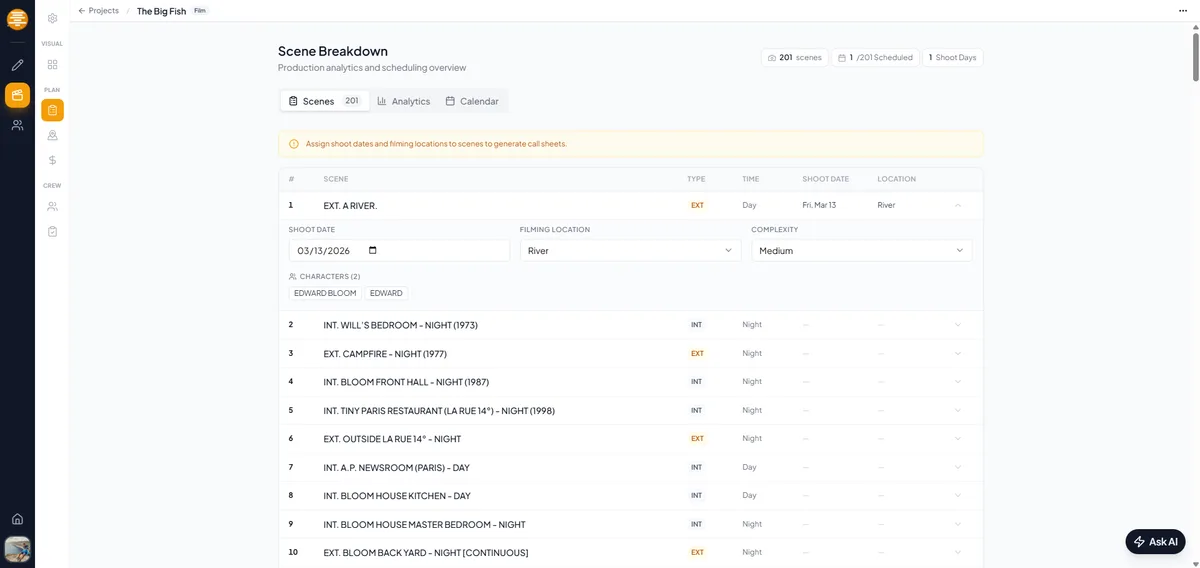
plotwell's production tools automatically break down your script by character. See at a glance which scenes each character appears in, track wardrobe continuity, and flag special requirements. The breakdown updates when your script changes, so you're never working from stale data.
From Page to Production
The character work you do in plotwell flows directly into production planning:
- Character profiles inform your casting breakdowns
- AI-extracted scene appearances feed into your shooting schedule
- Character images become visual references for your production team
- Relationship maps help you plan rehearsal groupings
Common Character Mistakes
The character without a wound. If your character has no internal damage, they have no reason to change. No change means no arc. No arc means no story.
The character who is always right. Characters who never make mistakes are boring. Let your protagonist be wrong. Let them fail because of their flaw, not despite it.
Describing instead of demonstrating. "Sarah is brave" tells us nothing. Show Sarah doing something brave when it costs her. Character is action under pressure.
Identical voices. If you can swap dialogue between characters without noticing, their voices aren't distinct enough. Cover the character names and read the dialogue. Can you tell who's speaking?
Forgetting supporting characters. Every character with a name should have a reason to exist and a clear function in the story. If two characters serve the same purpose, merge them.
Start With the Character You Fear
The character that's hardest to write is usually the most interesting one. They're hard because they force you to explore something uncomfortable, a worldview you disagree with, an emotion you avoid, a version of yourself you don't like.
Lean into that difficulty. That's where the truth lives, and truth is what makes characters feel real.