

Every great screenplay starts before the first scene heading. It starts with a beat sheet, a structural outline that maps your story's key turning points from opening image to final frame.
A beat sheet isn't a rigid formula. It's a tool that helps you test whether your story works before you spend months writing pages.
What Is a Beat Sheet?
A beat sheet is a list of story events (beats) that mark the major turning points in your narrative. Each beat is a sentence or short paragraph describing what happens and why it matters.
Think of it as the skeleton of your screenplay. The bones need to be right before you add muscle and skin.
The 15-Beat Structure
While there are many structural frameworks (three-act structure, Save the Cat, sequence method), most feature films hit these fundamental beats. We'll use Big Fish (written by John August) as our running example.
Act One: Setup (pages 1-25)
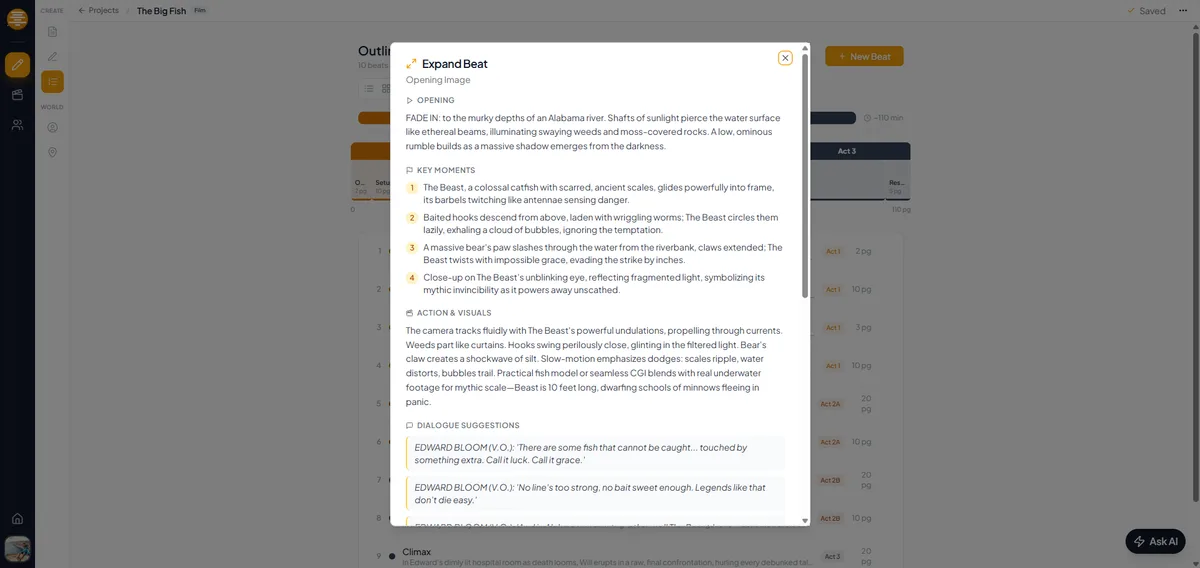
1. Opening Image (p. 1) A visual that establishes the tone and shows us the "before" snapshot of your protagonist's world.
Big Fish: A fat catfish swims underwater. Edward Bloom narrates about fish that cannot be caught, fish "touched by something extra." We're immediately in the world of tall tales.
2. Theme Stated (p. 5) Someone, often not the protagonist, says something that hints at the movie's central theme. The protagonist doesn't understand it yet.
Big Fish: "There are some fish that cannot be caught. It's not that they're faster or stronger than other fish. They're just touched by something extra." This frames the entire movie's question: what's the line between truth and story?
3. Setup (p. 1-10) Introduce your protagonist, their world, their flaw, and what they think they want. Plant everything the audience needs for later payoffs.
Big Fish: We see Edward telling The Beast story across three time periods (1973, 1977, 1987), each time to a less impressed Will. By the time Will is 17, he's fuming at his father's stories. We understand the central conflict without anyone explaining it.
4. Catalyst (p. 12) The inciting incident. Something happens that disrupts the status quo and makes the old world unsustainable.
Big Fish: Edward collapses. Will has to face what he's been avoiding: his relationship with his dying father and the stories he never believed.
5. Debate (p. 12-25) The protagonist hesitates. Should they accept the call to adventure? What's at stake? This creates tension before the commitment.
Act Two A: Fun and Games (pages 25-55)
6. Break into Two (p. 25) The protagonist makes a choice and enters the new world. There's no going back.
7. B Story (p. 30) A secondary storyline begins, usually a relationship that carries the thematic argument.
Big Fish: Will investigates his father's stories, visiting the places Edward described. The B Story is Will's journey from skeptic to believer.
8. Fun and Games (p. 30-55) The "promise of the premise." This is why the audience bought a ticket.
Big Fish: This is where we see young Edward's adventures: the giant, the circus, the hidden town of Spectre, the werewolf ringmaster. These sequences are the heart of the film, the reason people love it.
9. Midpoint (p. 55) A major shift. Either a false victory (things seem great but won't last) or a false defeat (things seem terrible but there's hope). The stakes escalate. The clock starts ticking.
Big Fish: Will finds evidence that one of Edward's stories is true. The line between fiction and reality blurs.
Act Two B: Bad Guys Close In (pages 55-75)
10. Bad Guys Close In (p. 55-75) Internal and external pressures mount. Allies scatter. The protagonist's flaw starts sabotaging their progress.
Big Fish: Will's skepticism strains every relationship. His need to know "the truth" pushes him further from the people who love him.
11. All Is Lost (p. 75) The lowest point. Something or someone is lost. The protagonist's old approach has completely failed.
Big Fish: Edward's condition worsens. Time is running out, and Will still hasn't reconciled with his father.
12. Dark Night of the Soul (p. 75-85) Mourning and reflection. The protagonist faces their flaw honestly. This is where real change begins.
Act Three: Resolution (pages 85-110)
13. Break into Three (p. 85) Inspired by the B Story and the lessons learned, the protagonist finds a new approach, one that requires them to change.
14. Finale (p. 85-110) The protagonist executes their new plan. Subplots converge. The theme is proven through action, not words.
Big Fish: Will carries his father to the river. The whole town waits. Will finally tells one of his father's stories himself, accepting that the stories are the truth of who Edward was.
15. Final Image (p. 110) A visual that mirrors the opening image but shows how everything has changed. The "after" to your "before."
Big Fish: The catfish swims away. The story becomes the truth.
Writing Your Beats
For each beat, write:
- What happens. The external event.
- What changes. The internal shift or new information.
- Why it matters. How this propels the story forward.
Keep each beat to 2-4 sentences. You're capturing the essential moment, not writing the scene.
Beat Sheet for TV Pilots
TV pilots follow a modified structure with act breaks for commercial television:
| Beat | Page | Purpose |
|---|---|---|
| Cold Open / Teaser | 1-3 | Hook the audience |
| Act One | 4-15 | Setup world + catalyst |
| Act One Break | 15 | Cliffhanger or question |
| Act Two | 16-30 | Complicate + midpoint |
| Act Two Break | 30 | Major escalation |
| Act Three | 31-42 | Crisis + climax |
| Tag/Button | 42-44 | Resolution + series hook |
For streaming (no commercial breaks), the structure is more flexible, but the beats still need to land.
Common Beat Sheet Mistakes
Too vague: "Something bad happens" doesn't help. Be specific about what, to whom, and what changes.
Missing emotional beats: All plot, no character. Every external event should trigger an internal response.
No escalation: If the midpoint and the All Is Lost moment feel equally bad, your story is flat. Each beat should raise the stakes.
Skipping the Debate: Jumping from catalyst to action makes your protagonist feel reckless rather than relatable. Let them hesitate. It makes the commitment meaningful.
Creating a Beat Sheet with plotwell
plotwell's Beats view is designed specifically for this workflow:
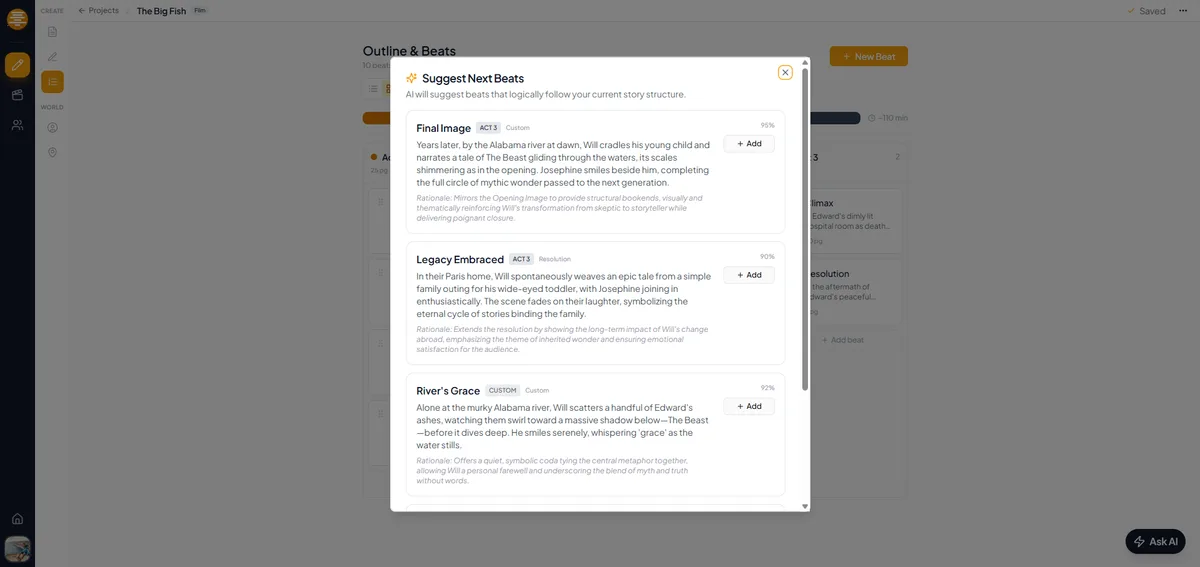
- Drag-and-drop beat cards. Rearrange your story structure visually. Move the midpoint, swap act breaks, find the right rhythm.
- Beat-to-script connection. Each beat links to scenes in your script. You can see your structure alongside your pages.
- AI brainstorming. Stuck on a beat? Use the AI chat assistant to explore options. Ask something like "Give me three possible midpoint reversals for a heist film where the protagonist is an art restorer" and get tailored suggestions that understand your project's genre and tone.
- AI-powered beat generation. Let the AI analyze your concept and generate a complete beat sheet as a starting point. It reads your project's logline, genre, and any existing notes to propose a structural outline you can refine.
- Context-aware AI. The AI assistant doesn't work in a vacuum. It has access to your full project: your concept, your characters, your existing scenes. So when you ask for help with your midpoint, it knows who your characters are and what's at stake.
- Export your beat sheet. Share it as a document for feedback before writing full scenes.
The goal is to solve structural problems when they're cheap to fix, before you've written 90 pages.
From Beats to Pages
Once your beat sheet feels solid, the writing goes faster because you always know where you're headed. Each writing session has a clear target: "Today I'm writing the Catalyst scene."
Some writers expand beats into a scene outline next (one line per scene). Others jump straight to pages. There's no wrong approach. The beat sheet is your safety net either way.